Will My Paralyzed Dog Walk Again
Dog owner Rob Beasom and his wife were out of town when they received a frantic call from their dog sitter. Barley, their 3-year-sometime male French bulldog, severely injure himself while jumping off the couch, rendering him paralyzed in his back legs. Beasom immediately fabricated plans to render home and called Barley'southward primary veterinarian. After Beasom described the situation, the veterinary told him to have Barley to the UC Davis veterinary hospital.
Upon Barley's arrival at UC Davis, critical care specialists in the Emergency Room consulted with the Neurology/Neurosurgery Service, equally Barley's astute paralysis certainly involved a spinal effect.
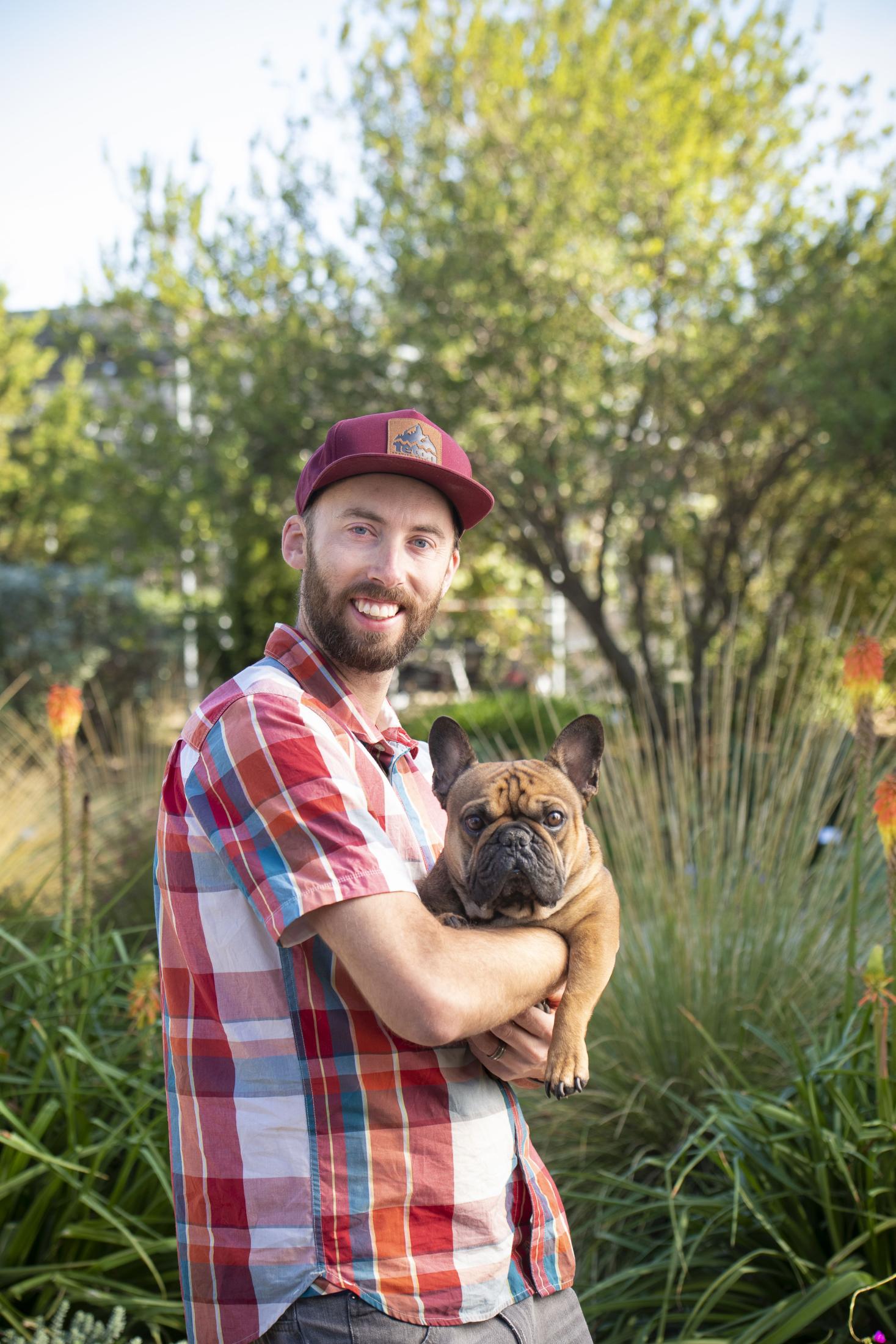
The neurologists' exam of Barley showed him to accept pain in his lower back region, consistent with an injury affecting the spinal cord in the region between the third thoracic vertebrae (upper to middle dorsum) and tertiary lumbar vertebrae (lower back). Barley's care team and so enlisted the assist of the Diagnostic Imaging Service in hopes that a CT scan would pinpoint the exact area of his injury. The browse did just that, revealing a herniated disc at L3-L4 resulting in compression of the spinal cord – the crusade of the paralysis. The imaging also showed bear witness of intervertebral disc disease (IVDD) which was causing degeneration at multiple disc sites.
On duty with the neurosurgeons that twenty-four hour period was Dr. Karen Park, a second-year small animal surgery resident. While surgery residents primarily spend their time with the Orthopedic Surgery and the Soft Tissue Surgery Services, they besides rotate through the Neurology/Neurosurgery Service to be trained in routine neurosurgery. Dr. Park would take the lead on Barley's case and run across him through discharge and follow-up appointments.
"I of the reasons why I wanted to get a surgeon is because the surgeries are non limited to ane area; and as a surgeon, there is so much more to a patient's intendance and possessor advice aside from the surgery itself," said Dr. Park. "There's a lot of involvement in the patient care attribute to a instance both before and after surgery. Equally surgeons, we are involved with both internal medicine and critical care aspects of cases, and (as residents) we train with other specialties, like neurology/neurosurgery with Barley's instance."
Multiple specialties and specialists working together under 1 roof sets UC Davis apart from about veterinary hospitals. While many hospitals will have a dozen or so specialty services, UC Davis has more than thirty, making it the near comprehensive veterinary hospital in the country. As the infirmary looks to expand and transition to the Veterinary Medical Centre (VMC) over the coming decade, those opportunities for collaboration will increase and become more efficient. And more than animals like Barley will benefit.
Barley'southward care team was confident they could correct his immediate problems with surgery, but his IVDD is a degenerative disease that could continue to cause spinal string pinch issues in the hereafter. IVDD affects the cartilage discs between the vertebrae, which normally human activity as a cushion between each vertebra. As the disc becomes mineralized or calcified over time, the abnormal disc material in the centre herniates, and it extrudes out towards the spinal cord. This results in compression, bruising, and sometimes bleeding around the spinal string and subsequent neurological signs, such as Barley beingness unable to movement his hind legs.
Dr. Park and neurology/neurosurgery kinesthesia fellow member Dr. Chai-Fei Li performed a hemilaminectomy surgery that relieved the compression of Barley's spine. During the procedure, surgeons drilled/opened a "window" in the lamina portion of the vertebrae. This procedure preserved the structural integrity of the spinal column, simply allowed the surgeons access to make clean out the disc expanse that herniated against the spine. One time that debris was cleaned out, Barley's spine was no longer compressed, assuasive the spinal cord and nerves to his hind legs to heal and eventually function properly again.
Drs. Park and Li likewise performed a procedure chosen a fenestration at nearby disc spaces to remove the aberrant disc material that is at run a risk for hereafter herniation. While this will not completely forbid future disc herniation, it may reduce the hazard.
Barley recovered well from his surgery. He was mildly ambulatory with good motor function in both hind limbs after three days of hospitalization. Dr. Park ordered strict cage rest for four to six weeks. While the bulk of Barley's recovery will occur in the first two to 3 months, it can take up to six to ix months for the spinal cord to completely heal from an injury.
Six weeks after surgery, Barley visited Dr. Park for his follow-up engagement. She is happy to report that Barley's recovery is going well, and he tin can gradually render to normal activeness at abode, starting with x-xv minute walks a few times a twenty-four hours. However, jumping off the couch and rough play are even so off limits for several months and to be limited for the balance of his life.
As function of the VMC projection, UC Davis volition construct an entirely new Pocket-sized Animal Clinic, expanding the size and scope of the electric current hospital. This will open new preparation opportunities for residents like Dr. Park, allowing them more feel in procedures like Barley'southward surgery, and continue to push the limits of veterinary medicine.
# # #
Source: https://www.vetmed.ucdavis.edu/news/surgeons-help-acutely-paralyzed-dog-walk-again

Post a Comment for "Will My Paralyzed Dog Walk Again"